
The Voice That Sounded Like Me, But Wasn't
Hermosa, I want to tell you about the moment I realized the voice in my head wasn't actually mine.
MONEY MINDSETLEADERSHIPCHAKRAS
Marti Angel™
7/13/20263 min read
Hermosa, I want to tell you about the moment I realized the voice in my head wasn't actually mine.
I grew up hearing, gently but clearly, that niñas se ven y no se oyen — girls are seen, not heard. Not assertive. Not opinionated. College wasn't really a conversation in our house for girls like me. This wasn't said to hurt me. It was just how things were. But a child doesn't know the difference between “this is our culture” and “this is who I am.” I absorbed it as the second thing.
For years, that belief didn't sound like my mother anymore. It sounded like me. A voice that shows up the moment something good is about to land — a client saying yes at my real rate, an opportunity I actually wanted — and tells me I haven't earned it. Worse, it tells me that wanting it at all means I've stopped being a servant leader and started being selfish.
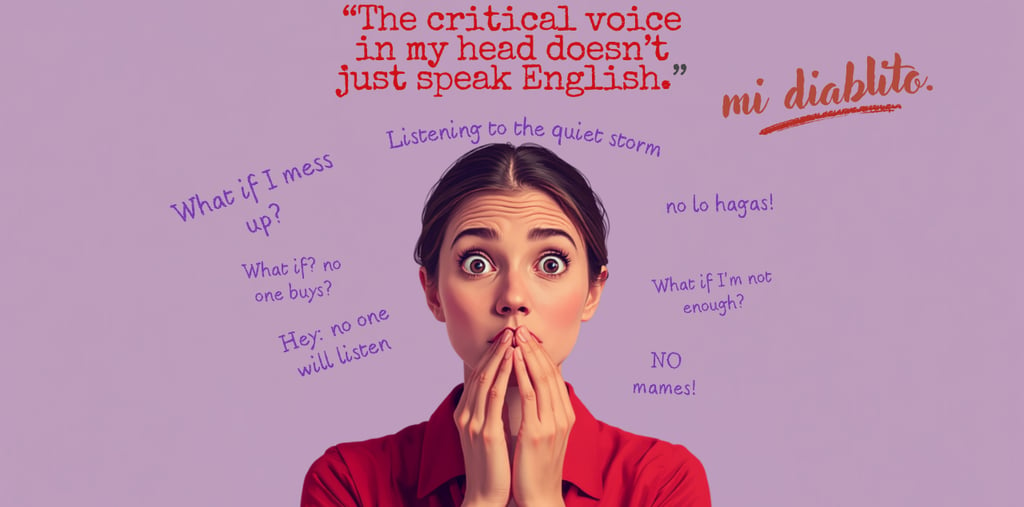
I call that voice mi diablito, and here's the part that still catches me off guard: it's fully bilingual. It speaks to me in English. It speaks to me in Spanish. It knows every language I know, which makes sense — it grew up in the same house.
The turning point wasn't winning an argument with it. It was realizing this was never a fair debate to begin with. It was a mito. A myth, inherited, not chosen. Once I could name it as a mito instead of a fact, I could finally say the sentence underneath it: I am inherently worthy, exactly as I am.
Saying that sentence once didn't fix anything, though. Hermosa, I wish I could tell you it did. What I've learned instead is that this is not a destination. It's a daily practice — you don't arrive at self-worth and get to stop working on it. You practice it the way you practice anything: imperfectly, repeatedly, especially on the days it feels hardest.
Two things help me most, and I do them daily, not just when I remember. First, I question the voice before I believe it — don't believe anything you hear inside your head without questioning it first. I ask myself: would I accept this if a client said it to me? Second, I answer mi diablito out loud, in whichever language it spoke to me in. Out loud, in my own voice, not its voice.
Something else I've learned this year: your energy system doesn't work in separate, isolated rooms. When one chakra is out of balance — say, a solar plexus that was taught power was dangerous for a girl — it sets off a chain reaction through the others. One imbalance touches the next, and soon the whole system is more vulnerable to every negative thought that comes knocking. That's exactly what mi diablito was counting on.
I won't pretend this practice gets easier every day. Some days I forget entirely, and mi diablito gets a full, uninterrupted turn at the microphone. What's changed isn't that the voice disappeared — it's that I notice it faster now, and I know what to do the moment I do.
I think about this constantly with the Latina authors and MujerPreneurs I talk to every week. So many of us were handed the exact same mito, in one form or another — be seen, not heard. And so many of us are doing the quiet, unglamorous work of unlearning it, daily, together.
And every week, I write more of this in real time, as I work through it myself.
Come read it with me. I'll be there.
Chula, if a voice inside your head has been telling you to stay small, this is your permission to question it today, and again tomorrow.
Always remember: Juntas podemos más.
#juntaspodemosmas