
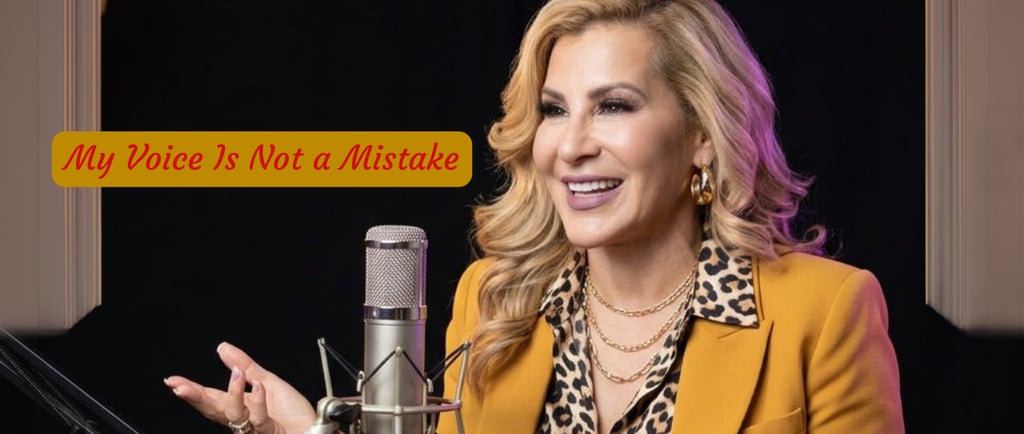
My Voice Is Not a Mistake: Healing the "Niñas Se Ven y No Se Oyen" Wound
If you were raised believing that speaking up was bad manners, that having an opinion made you "respondona," or that silence was the correct way to be a "good girl" — this one's for you.
SAN DIEGO LATINA LEADERMONEY MINDSETLEADERSHIPOVERCOMING DOUBTHOPE
Marti Angel™
7/20/20262 min read
If you were raised believing that speaking up was bad manners, that having an opinion made you "respondona," or that silence was the correct way to be a "good girl" — this one's for you.
What happens when you silence a girl?
Her voice doesn't disappear. It hides. And a hidden voice stays alive underneath the surface — showing up later as anxiety before you speak in a meeting, as resentment that quietly piles up, as a body that tenses every time you're about to say what you actually think.
This is childhood conditioning doing exactly what it was built to do: keep you small, agreeable, and quiet, long after the original threat is gone.
This kind of conditioning is common enough that it has a name in trauma-informed circles: the "good girl" wound. It's not unique to any one culture, but for Latinas it often comes wrapped in a specific phrase — niñas se ven y no se oyen — that turns the wound into a rule everyone in the family quietly agrees to enforce.
The solar plexus connection
Your solar plexus — the energy center right above your navel — governs personal authority and self-trust. If you want the full breakdown of how this chakra works and why it closes in childhood, I go deeper on it in last week's Substack piece, where we started this two-part series.
When that center closes early, it doesn't just affect how you feel about speaking up — it shapes what you charge for your work, what boundaries you set with clients, and how long you stay in situations that no longer serve you. Personal authority and business authority run on the same wiring.
I see this pattern constantly with the women I coach: the pricing problem that isn't actually a pricing problem, the "difficult client" who's really just the first person in months she's tried to say no to. We spend so much energy looking for better scripts and better strategy when the real block is a chakra that never got permission to open.
This week's practice
Two steps, every day, all week:
• Question the voice that tells you to stay quiet. Ask it directly: whose voice is this? It's almost never yours.
• Answer it out loud — in the language it appeared in. Spanish, English, or both. Your wound was bilingual; let your healing be too.
Do this even when it feels small or silly. The point isn't the performance of it — it's the repetition. Every time you interrupt the automatic "stay quiet" response with a deliberate, spoken answer, you're teaching your nervous system a new default. That's not affirmation-poster thinking; it's how conditioning actually gets rewired, one repetition at a time.
Why this matters right now
Reclaiming your voice is reclaiming your solar plexus — your center of personal authority. It's the work we started last week with the chakra itself, and this week we bring it into daily, physical action.
If you want to go deeper on chakra work and inner-child healing, want it in Spanish
Gumroad (ebook en español): https://martiangel.gumroad.com/l/yltof
English here:
Amazon: https://www.amazon.com/Change-Your-Energy-Life-Personal-ebook/dp/B0078IMO8S?ref_=ast_author_mpb